

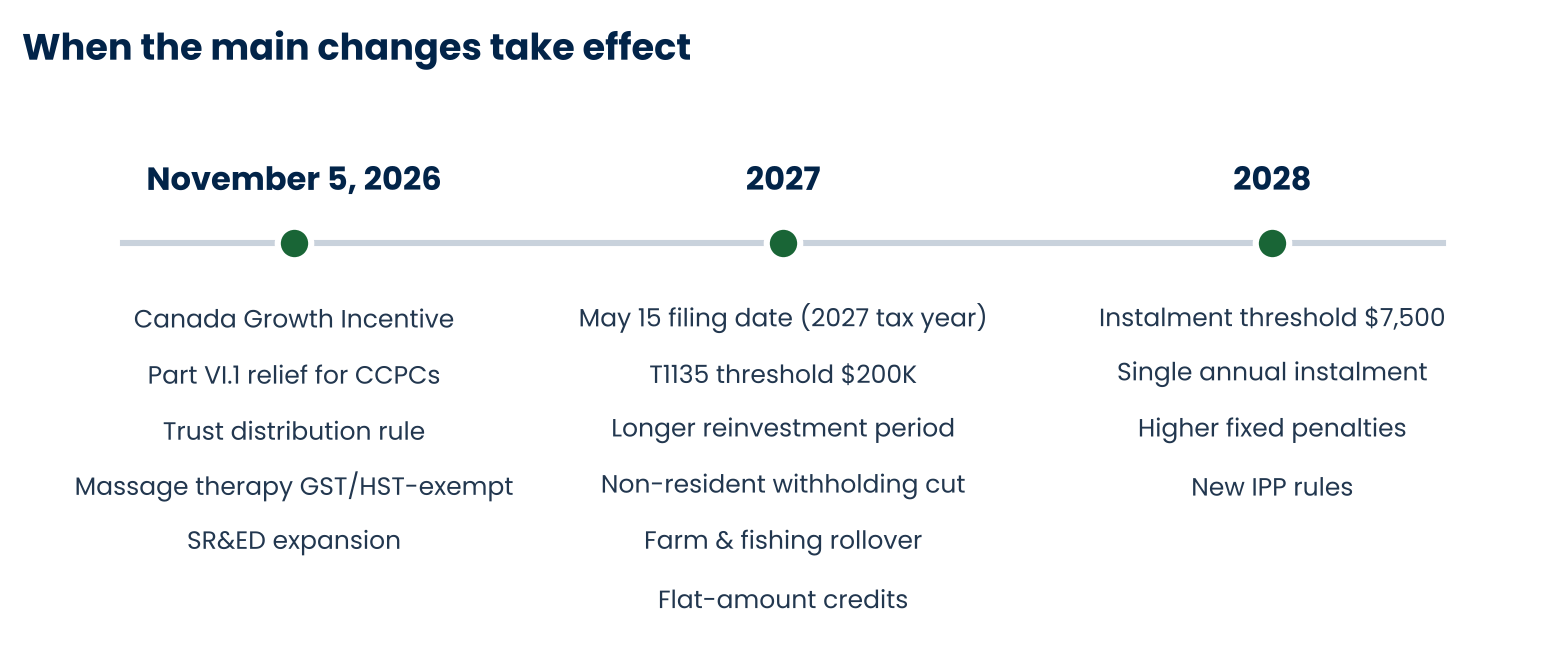
On November 5, 2026, Finance Minister François-Philippe Champagne tabled Budget 2026, Masters of our Destiny. There are no changes to corporate or personal tax rates. Instead, the budget focuses on encouraging investment in Canadian businesses, simplifying compliance and tightening enforcement.
These are budget proposals. Some take effect immediately, but none is law until Parliament passes it. Below are the tax highlights, with our commentary on what they mean for owner-managed businesses and their owners.
Business Tax Measures
Corporate Loss Transfers (Consultation)
Each corporation is taxed on its own, so a loss in one company cannot be used directly against income in a related company. Today, groups rely on amalgamations, wind-ups or intercompany financing to achieve this, which can be complex and costly. The government is consulting on a rule that would let corporate groups transfer non-capital losses among group members, including how qualifying groups would be defined and how provincial revenues would be protected.
Effective: consultation open until January 8, 2027.
What This Means for You
A simple loss transfer system would help groups with an operating company and a holding or real estate company use losses right away, without restructuring. The details will matter, so we will watch the consultation closely.
SR&ED Expansion
Eligible SR&ED activities will expand to include tests, validations and studies needed to meet regulatory requirements for the first approval or certification of a product or process, as long as they relate directly to an eligible project. Eligible costs will also include registering and maintaining intellectual property protection for IP developed in an eligible project.
Effective: tax years beginning on or after November 5, 2026.
What This Means for You
Companies that bring regulated products to market, such as medical devices, dental laboratories and food producers, should review whether certification and patent costs can now be claimed.
EIFEL Interest Limits
The proposed exceptions to the interest deductibility limits (EIFEL) for purpose-built rental housing and regulated energy utilities will extend to money borrowed by one group member and used by another affiliated corporation, trust or partnership, including partnerships in which the group holds at least a 40% interest.
Effective: tax years beginning on or after October 1, 2023.
Taxable Preferred Shares (Part VI.1 Tax)
Part VI.1 tax applies to dividends on preferred shares that have debt-like features. Canadian-controlled private corporations (CCPCs) will be fully exempt, so their dividends on taxable preferred shares will no longer attract this tax.
Effective: dividends paid on or after November 5, 2026.
What This Means for You
This tax often caught ordinary private company planning, such as estate freezes, redemptions of freeze shares and post-mortem planning. Removing it makes these transactions simpler and cheaper.
Personal Tax Measures
Canada Growth Incentive: $15 Million Capital Gains Exemption
A Canadian-resident individual will be able to exempt up to $15 million of capital gains, per business, on the sale of qualifying shares of a qualifying corporation. The individual must be at least 18 when the shares are acquired and resident in Canada throughout the year the exemption is claimed. The shares must be issued directly to the individual (or to a partnership of which they are a member) and owned directly.
Many businesses do not qualify, including consulting, professional practices (such as accountants, lawyers, physicians and other health care practitioners, engineers and architects), businesses that depend on the skill or reputation of employees, agriculture, fishing, forestry, mining, finance, insurance, utilities, real estate, food and accommodation, arts and recreation, and franchised or licensed businesses. Integrity rules will follow, including rules to stop the limit from being multiplied across several corporations.
For alternative minimum tax (AMT), 30% of the exempt gain is included, as with the lifetime capital gains exemption (LCGE). Claiming the new exemption limits the LCGE on the same company, and the reverse. Both this exemption and the exemption on sales to an employee ownership trust or worker cooperative can be claimed on the same sale.
Effective: qualifying shares issued on or after November 5, 2026 and before 2037.
What This Means for You
Existing shares do not qualify, and shares held through a family trust or holding company will not qualify. Founders who want access to the exemption need to plan the share structure at the start. The AMT on large exempt gains could be significant, so recovering it over the following seven years should be part of the plan.
Canada Growth Incentive: Small Business Investment Rollover
Individuals can already defer gains on eligible small business shares by reinvesting the proceeds in replacement shares. The replacement period will extend from the year of sale and the following year to the year of sale and the next three calendar years. Investors who sign an agreement to provide capital for future equity (such as a SAFE) can defer for up to five years. Interest will apply to proceeds that are not reinvested. The active business asset test during the holding period is relaxed from “all or substantially all” to “primarily”, although the stricter test still applies when the shares are issued and sold.
Effective: dispositions on or after January 1, 2027.
New T1 Filing Date
All individuals, including the self-employed and their spouses or common-law partners, will file and pay by May 15. The self-employed currently file by June 15.
Effective: 2027 and later tax years.
What This Means for You
Self-employed clients will need their records ready a month earlier than they do today, starting with their 2027 returns.
Foreign Property Reporting (Form T1135)
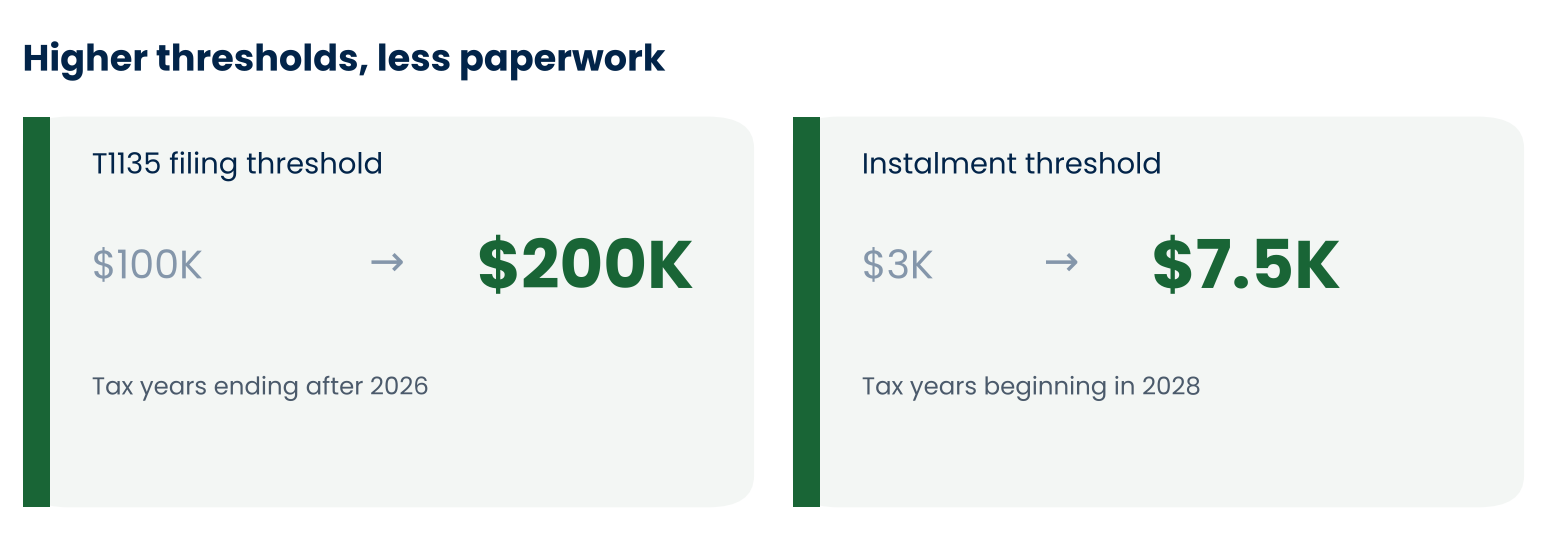
The threshold for filing Form T1135 rises from $100,000 to $200,000 of foreign property cost, and simplified reporting will be available up to $500,000 (currently $250,000).
Effective: tax years ending after 2026.
Instalment Payments
The instalment threshold rises from $3,000 to $7,500 for corporations and for individuals outside Quebec ($1,800 to $4,500 federal for Quebec residents), indexed to inflation. Individuals whose main income is from a business, profession or commissions can make a single annual instalment of two-thirds of their tax owing by December 31, instead of quarterly payments.
Effective: tax years beginning on or after January 1, 2028 (threshold) and the 2028 tax year onward (annual instalment).
Intergenerational Farm and Fishing Rollovers
The tax-deferred rollover of farm and fishing property to a child or grandchild will extend to nieces and nephews.
Effective: transfers on or after January 1, 2027.
Mineral Exploration Tax Credits
The 15% Mineral Exploration Tax Credit and the 30% Critical Mineral Exploration Tax Credit are extended to flow-through share agreements entered into by March 31, 2032, and antimony is added as a critical mineral.
Optional Flat Amounts for Deductions and Credits
To reduce receipt-keeping, individuals can claim flat amounts instead of actual expenses: moving expenses $1,000; labour mobility for tradespeople $1,500 per year; home accessibility $1,000 (one time); adoption $1,200 per child; and the clergy residence deduction $1,000 per month, up to $12,000 a year.
Effective: 2027 and later tax years.
Medical Expense Credit and Disability Supports Deduction
Documentation requirements will be reduced, and optional flat amounts will be allowed for gluten-free food ($1,000, from the 2026 tax year), incontinence products ($500) and service dogs ($2,000), the last two from 2027.
Other Personal Measures
- The Canada Caregiver Credit becomes refundable from 2027.
- Commission employees who claim travel or vehicle expenses can still claim other employment expenses, up to their commission income, from 2027.
- Employer or other arm’s-length funding will no longer disqualify a program for the scholarship exemption, from 2027.
- The volunteer firefighter and search and rescue credits combine into a single 14% credit on $6,000, from 2027.
- The government is consulting on an “RRSP for life” that would remove the need to convert to a RRIF at age 71, while keeping minimum withdrawals. Submissions are due January 8, 2027.
- The Northern Residents Deductions are simplified, from 2027.
- Qualifying family members can permanently open an RDSP as plan holder.
- Private foundations will no longer be subject to the excess corporate holdings regime, and will instead be barred from controlling a corporation, from 2027.
- The Advance Canada Workers Benefit is phased out and the benefit is enhanced and renamed the Build Canada Workers Benefit.
Trust Distributions to Non-Residents
A trust can no longer distribute property on a tax-deferred basis to a corporation or partnership that has a direct or indirect non-resident shareholder or partner.
Effective: distributions on or after November 5, 2026.
What This Means for You
Family trusts with corporate beneficiaries should be reviewed before the next distribution, especially where any family member or shareholder has moved abroad.
Registered Pension Plans and Individual Pension Plans
A pension plan whose registration is revoked will face a 10% special tax and be treated as a retirement compensation arrangement, for revocations after 2026. The definition of an individual pension plan (IPP) is broadened from 2027. From 2028, IPPs will be subject to the advantage, non-qualified investment and prohibited investment rules, and an IPP whose assets exceed 200% of its liabilities can have its registration revoked.
What This Means for You
Owner-managers with an IPP should review its investments and funding level before these rules start to apply in 2028.
Indirect Tax Measures
GST/HST Exemption for Massage Therapy
Massage therapy provided by qualifying massage therapists is added to the list of exempt health care services. This applies to sole practitioners, incorporated therapists and multidisciplinary clinics.
Effective: supplies made after November 5, 2026.
- Stop Charging GST/HST
Update invoices, booking software and point-of-sale systems so tax is no longer charged on massage therapy services. - Loss of Input Tax Credits
Exempt services do not earn input tax credits, so GST/HST paid on rent, supplies and equipment used for massage therapy becomes a cost. Pricing should be reviewed with this in mind. - Registration
Therapists who make only exempt supplies may no longer need to be registered. Clinics that also sell taxable products or services must stay registered and charge tax on those sales. - Adjustments for Business Property
Equipment that shifts to exempt use, or a cancelled registration, can trigger change-in-use adjustments that require GST/HST to be repaid.
What This Means for You
Massage therapists and clinics should review their registration, pricing and capital property now, before filing their next GST/HST return.
Other Indirect Tax Measures
- Large financial institutions can seek approval of their GST/HST input tax credit allocation methods for three years at a time, for fiscal years beginning after June 30, 2027.
- A common cannabis excise stamp will be introduced for participating provinces and territories, usable from January 1, 2028.
- Excise warehouses holding non-duty-paid packaged spirits must post security of between $5,000 and $2 million per licence.
- Fuel excise wholesaler licensing is broadened, with a one-time payment where tax was paid twice on the same fuel.
International Tax Measures
Sales of Taxable Canadian Property by Non-Residents
Purchaser withholding on sales of taxable Canadian property drops from 50% to 30% for specified property and from 25% to 15% for other capital property. Fully tax-deferred section 85 rollovers will be exempt from withholding if the election is filed and the CRA is notified within 30 days. The anti-avoidance period for a deferred transfer followed by a sale by a non-resident extends from three to five years.
Effective: dispositions on or after January 1, 2027.
Tax Administration Measures
Administrative Penalties
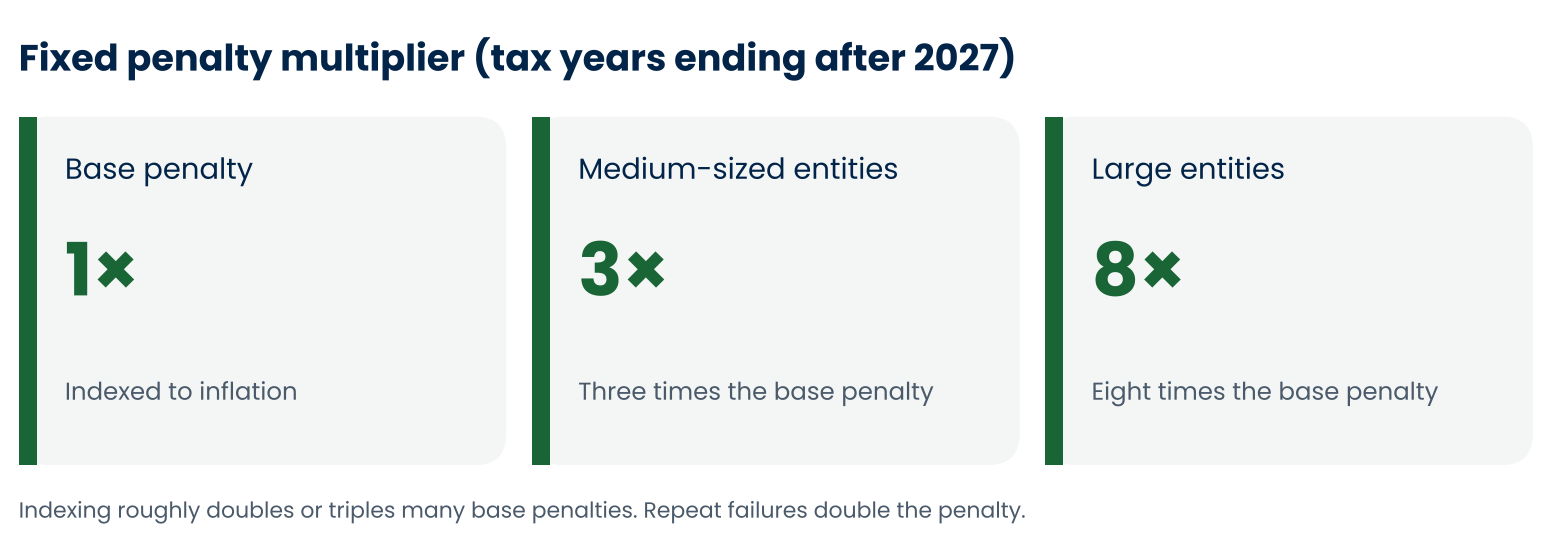
Most fixed-dollar penalties will be increased for inflation and indexed every five years. Individuals and smaller corporations stay at the base amount. Medium corporations (more than $10 million and up to $50 million of taxable capital, including related corporations) pay three times the base amount, and large corporations (over $50 million) pay eight times. Partnerships are sized by gross revenue. New penalties for repeated failures generally double the base penalty.
Effective: tax years ending after 2027.
What This Means for You
The size tests are based on taxable capital, not profit, so capital-intensive businesses such as real estate, construction and dealerships may be treated as medium or large. Elections and information returns (T106, T5013, T1135) must be filed on time. A late section 85 election, for example, could cost up to $24,000.
Objections to Assessments
The deadline to object will be one year after the notice of assessment is sent. For individuals and graduated rate estates, it will be the later of one year after the notice and two years after the filing due date. Extensions of time will no longer be available.
Effective: assessments sent three months or more after royal assent.
What This Means for You
Every assessment should be reviewed as soon as it arrives. A missed deadline will no longer be fixable.
Tax Debts Reported to Credit Bureaus
The CRA will be able to report income tax and GST/HST debts over $50,000 to credit bureaus once objection and appeal rights have expired, after 30 days’ written notice and reasonable collection efforts.
Effective: royal assent.
Other Administrative Changes
- Corporations will no longer need to file certified director resolutions with certain elections, such as capital dividend elections, once enacted.
- The CRA will be able to confirm a member’s death to a pension plan administrator.
Previously Announced Measures
The budget confirms that the government will proceed with several previously announced measures, including:
- the Productivity Mega Deduction (full first-year write-off for a broad range of capital assets);
- reporting requirements for non-profit organizations;
- non-compliance with CRA information requests;
- Disability Tax Credit changes;
- the Red Seal Completion Bonus;
- the carbon capture, utilization and storage investment tax credit;
- transfer pricing and hybrid mismatch rules; and
- the GST/HST reverse charge mechanism.
Final Thoughts
Budget 2026 brings real opportunities for owner-managed businesses, along with tighter deadlines and much higher penalties. We are reviewing client files for:
- Estate Freezes and Redemptions
Under the new Part VI.1 rules. - Share Issuances
Positioning founders for the Canada Growth Incentive. - Trust Distributions
Distributions to corporate beneficiaries with non-resident owners. - Filing Calendars
Elections and information returns before the new penalties begin. - CRA Assessments
Assessments that may need an objection under the new one-year deadline. - Massage Therapy Clients
GST/HST registration, pricing and change-in-use adjustments.
To discuss how Budget 2026 affects you or your business, contact us at 647-300-2981, email info@zmacpa.ca, or visit zmacpa.ca.
This article is a general discussion of certain tax and accounting matters, based on budget proposals as tabled on November 5, 2026 that may change before they are enacted, and should not be relied upon as tax or accounting advice. If you require tax or accounting advice, we would be pleased to discuss the issues in this article with you.